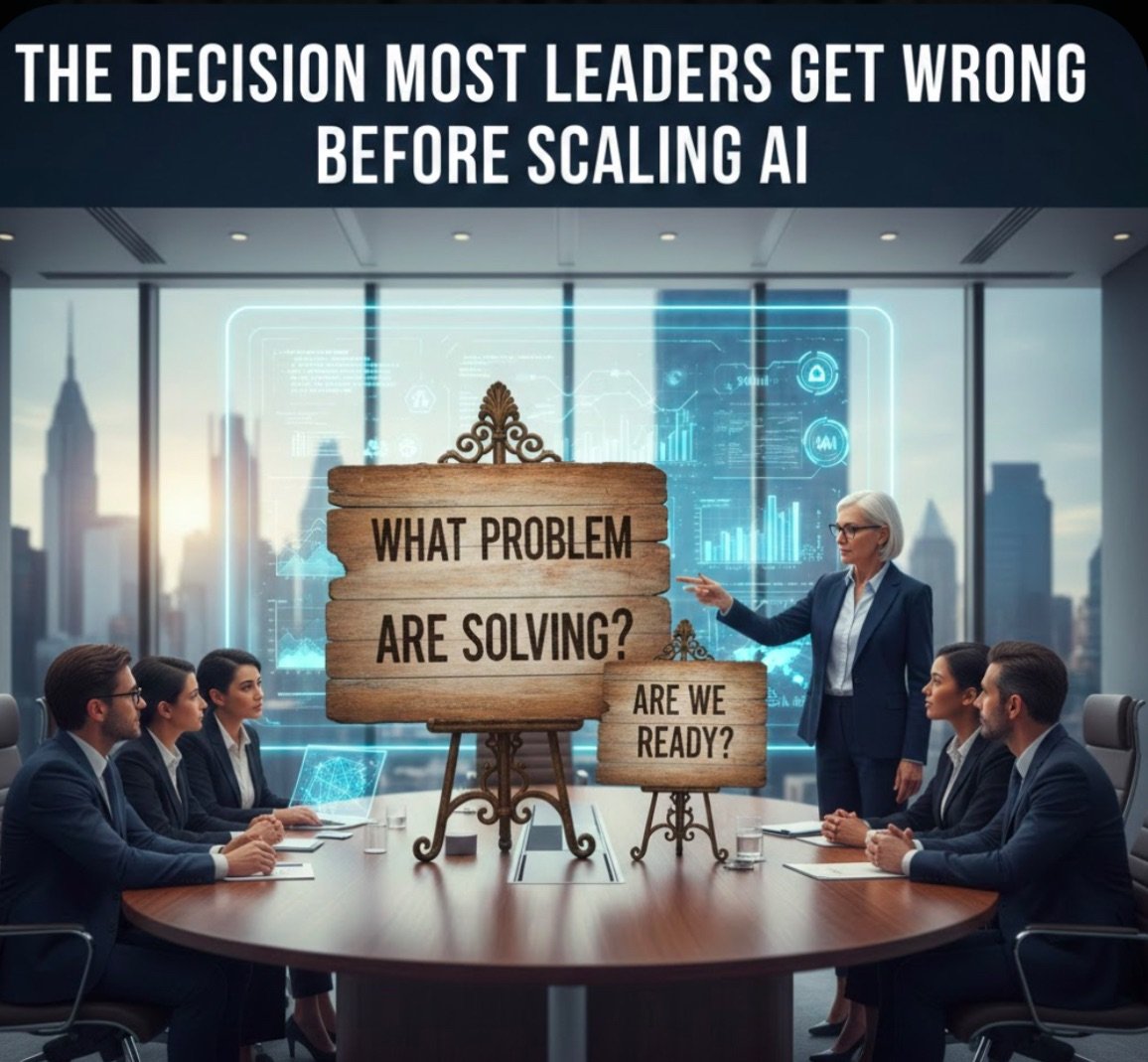
Artificial intelligence is no longer an emerging concept. It is a core driver of competitive advantage across industries. Yet many organizations struggle to move from experimentation to meaningful scale. The reason is rarely a lack of funding or talent. More often it is a single flawed decision made early in the journey.
Before scaling AI most leaders focus on choosing technology. That choice feels urgent and visible. Unfortunately it is also the wrong place to start.
This decision quietly undermines even the most ambitious AI strategies.

The Core Mistake Leaders Make
The most common mistake leaders make before scaling AI is prioritizing technology selection over business clarity and organizational readiness.
Leaders ask which AI platform to adopt or which model is most advanced. What they should be asking instead is what business outcome they are trying to achieve and whether their organization is prepared to operationalize AI at scale.
When technology leads and strategy follows AI becomes a solution in search of a problem. This results in impressive demonstrations that never translate into measurable business value.
Why This Mistake Is So Common
This decision error is understandable and often driven by external and internal pressures.
AI is surrounded by hype. Success stories dominate headlines and create urgency to act quickly. Boards and investors expect visible progress which makes technology purchases feel like momentum. At the same time business and technical teams often operate in silos. Without strong alignment technology decisions become substitutes for strategic decisions.
In this environment selecting tools feels productive even when foundational questions remain unanswered.
The Cost of Getting This Wrong
When leaders lead with technology instead of outcomes the consequences are predictable.
AI solutions see low adoption because they do not align with real workflows. Costs rise without corresponding returns. Proofs of concept succeed in isolation but fail in production. Teams grow frustrated as effort does not translate into impact. Governance ethics and compliance gaps emerge because they were not designed into the system from the beginning.
The organization ends up with AI capability but no real advantage.
The Right Decision to Make Before Scaling AI
The correct decision before scaling AI is not about tools. It is about intent readiness and execution.
Leaders must clearly define the outcome they want to achieve and confirm that the organization has the data processes and people required to deliver that outcome.
This means shifting the core question from which AI solution should we buy to what business result are we targeting and how will AI enable it.
When outcomes are clear technology becomes an enabler rather than a distraction.
Defining Outcomes That Matter
Effective AI initiatives start with business value not technical capability.
Leaders should articulate what success looks like in measurable terms. This could include increasing revenue reducing operational costs improving customer experience managing risk or strengthening competitive positioning.
Once the outcome is defined it must be tied to clear metrics. These metrics guide decision making ensure accountability and provide a benchmark for success.
Assessing Organizational Readiness
Before scaling AI leaders must assess whether the organization is prepared to support it.
Data readiness is critical. This includes data quality accessibility governance and trust. AI systems are only as effective as the data they rely on.
Equally important is workflow readiness. AI must integrate into real decision making processes not exist as a separate layer.
Finally leadership must assess people readiness. Teams need the skills confidence and incentives to work with AI systems and act on their outputs.

Governance Is Not Optional
AI at scale introduces ethical legal and operational risks. These cannot be addressed after deployment.
Leaders must establish governance frameworks that cover data privacy model transparency bias mitigation and regulatory compliance. This is especially critical in sectors such as finance healthcare and public services.
Strong governance builds trust internally and externally and ensures AI systems can scale responsibly.
A Practical Framework for Scaling AI Successfully
Leaders can avoid common pitfalls by following a structured approach.
First define the business outcome in clear measurable terms.
Second identify the decisions or workflows that influence that outcome.
Third assess data process and people readiness to support those workflows.
Fourth establish governance and risk controls from the outset.
Finally select technology and partners that align with the defined outcome and constraints.
This sequence ensures that technology serves strategy rather than replacing it.
What Effective AI Leadership Looks Like
Leaders who scale AI successfully think beyond features and focus on impact. They align business technical and operational teams early. They invest in change management and capability building not just software. They treat risk governance and ethics as strategic priorities rather than compliance checkboxes.
Most importantly they understand that AI is not a one time deployment but a continuous capability that evolves with the business.

AI does not fail because the technology is weak. It fails because decisions are made in the wrong order.
The most important decision before scaling AI is not which tool to adopt but whether the organization is clear aligned and ready to turn intelligence into action.
When leaders get this right AI moves from experimentation to execution and from novelty to lasting value.
AI scales not because of technology but because of disciplined decision making.